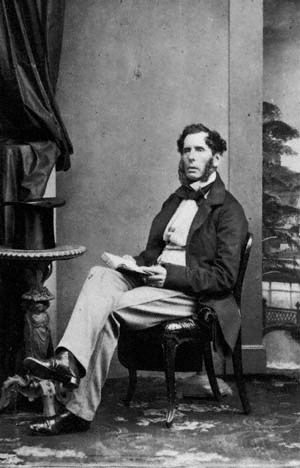
 Edward Horsman (February 8, 1807 - November 30, 1876) was a prominent British Victorian politician, independent Liberal Member of Parliament, and Chief Secretary for
Ireland.
Edward Horsman (February 8, 1807 - November 30, 1876) was a prominent British Victorian politician, independent Liberal Member of Parliament, and Chief Secretary for
Ireland.
Queer Places:
Rugby School, Lawrence Sheriff St, Rugby CV22 5EH, United Kingdom
University of Cambridge, 4 Mill Ln, Cambridge CB2 1RZ
Edward Horsman (February 8, 1807 - November 30, 1876) was a prominent British Victorian politician, independent Liberal Member of Parliament, and Chief Secretary for
Ireland.
Born in Stirling, Scotland, he was the son of William Horsman, Esq., and Jane Dalrymple, daughter of Sir John Dalrymple, 4th Baronet, and sister to the 7th and 8th Earls of Stair. Through his mother, Horsman was well-connected to the Scottish landed gentry. He entered the prestigious Rugby School at Midsummer 1819 and subsequently matriculated at Trinity College, Cambridge, on 2 December 1823. Though he did not complete a university degree, he distinguished himself as an athlete, earning a cricket "blue" for playing in three university matches for Cambridge in 1827 and 1829.
Following his time at Cambridge, he studied law and was admitted as an advocate to the Scottish Bar in 1832, though he practiced law only briefly before shifting his ambitions toward politics and enterprise. He was also a member of the elite intellectual and social society known as the Cambridge Apostles, placing him in intellectual circles alongside major thinkers of the era.
Horsman spent decades in the House of Commons, representing multiple constituencies across a long career characterised by fierce independence, fiery rhetoric, and frequent friction with party leadership:
After an unsuccessful run in 1835, Horsman won election as a Moderate Liberal for Cockermouth on 15 February 1836, holding the seat until July 1852.
Following a brief electoral defeat, he returned to Parliament on 28 June 1853 representing Stroud, serving until November 1868.
From May 1869 until his death, he represented Liskeard. By this stage, his increasing political alienation from the mainstream Liberal leadership led to challenges from more progressive candidates within his own party.
In January 1840, Horsman publicly censured James Bradshaw, M.P. for Canterbury, for insulting Queen Victoria and showing covert sympathy for the Chartist movement. The exchange resulted in a formal challenge and a duel fought at Wormwood Scrubs, which ended without serious injury after Bradshaw ultimately apologized.
He held brief executive office as Junior Lord of the Treasury from September to August 1841 under Lord Melbourne's administration.
Horsman gained a formidable reputation as a parliamentary crusader against perceived abuses within the established Church. He fiercely attacked the ecclesiastical policies of Lord John Russell’s ministry and the legislative power of bishops, launching multiple high-profile motions and speeches that earned him vocal detractors (such as Henry Goulburn, who dismissed him as a "disappointed man" frustrated by a lack of higher office).
Appointed Chief Secretary for Ireland by Lord Palmerston in March 1855, Horsman was sworn into both the British and Irish Privy Councils. He resigned the post in April 1857, thereafter pivoting to a permanently independent posture in the Commons.
Alongside Robert Lowe (later Viscount Sherbrooke), Horsman vehemently opposed William Ewart Gladstone's 1866 Reform Bill. During the fierce legislative debates, John Bright famously dubbed Horsman and Lowe's tiny faction the "Cave of Adullam"—inviting all political malcontents and those in distress to join their resistance against democratic expansion—cementing Horsman's legacy as a stubborn conservative-leaning Liberal.
In 1851, Horsman expanded his economic interests overseas by purchasing land in Malaysia from the East India Company to develop the Penang Sugar Estates in Province Wellesley. Remaining an absentee landlord based primarily in England, he scaled the enterprise into the largest plantation holding in the region.
However, the venture proved financially unsustainable. Initially propped up by financial bailouts from his brother-in-law, Sir John William Ramsden, the business collapsed under mounting debt. Horsman was declared bankrupt in 1874, at which point Ramsden settled with creditors and took full title to the estates.
On 18 November 1841, Horsman married Charlotte Louisa Ramsden, the only daughter of M.P. John Charles Ramsden.
Toward the end of his life, Horsman's health declined, and he died in Biarritz, France, on 30 November 1876 at the age of 69. He was buried there on 2 December 1876.
Standard historical records, parliamentary biographies (such as the Dictionary of National Biography), and political histories of the Victorian era contain no evidence, documentation, or suggestions of same-sex relationships or queer identity concerning Horsman.
While Horsman was a member of the Cambridge Apostles during an era when several members (such as Arthur Hallam and Richard Monckton Milnes) participated in homosocial or homoerotic romantic networks typical of elite university societies, historical scholarship on the Apostles does not link Horsman himself to any unconventional romantic or sexual preferences. His life followed the conventional nineteenth-century upper-class trajectory of marriage, fatherhood (through his union with Charlotte Louisa Ramsden), and public heteronormative social standing.
References:
 The Cambridge Apostles, 1820-1914: Liberalism, Imagination, and Friendship in British Intellectual and Professional Life 1st Edition by W.C. Lubenow |
Other references:
Support this project
This website is a passion project researched, developed, and funded entirely by me. If you find the content valuable and would like to help support the ongoing research and hosting costs, any contribution is deeply appreciated.
Thank you for keeping this independent resource alive!
My books on Amazon: Elisa Rolle's books